Wednesday, October 30, 2013

Halloween Reads

Halloween casts an eerie glow on our reading. We choose spooky books and read in hushed whispers. We flip through old favorites and delight in the dark and creepy tales. We let scary books creep in and give us a little chill.

Here are some of our favorite Halloween-time stories. None of these specifically name Halloween, but they each illustrate the spookiness of the season.


The Ghost-Eye Tree, by Bill Martin and John Archambault, takes readers to a quaint country home where two children must walk to town in the dark to fetch a bucket of milk for their mother. They dread passing the ghost-eye tree, so named because it appears to have two glowing eyes that stare at the children and branches that reach like arms.
                                         
 
This story has enough suspense to keep us turning the pages and enough subtle creepiness and realism to give us the chills. This is by far Aidyn's favorite spooky tale, and he loves cuddling up and reading it with me every year.

In a Dark Dark Room and Other Scary Stories, by Alvin Schwartz, is packed with intricately illustrated drawings and scary tales. Many of the stories have moments that cause us to jump but all in good fun. Some of the stories are pretty creepy and macabre, and so may be unsuitable for some children. However, Aidyn loves the stories, even if he remembers the little twist endings.


Bony-Legs, by Joanna Cole, is another favorite. A Russian folktale, Bony-Legs isn't exactly scary, but it has fantastical fairy tale elements that feel creepy as you read (like a witch that eats little children). Despite the creepiness, there are a wealth of messages within the story, like the themes of charity and bravery.


Yesterday, after reading the trio of spooky stories, we talked about elements of horror fiction, what makes these stories particularly creepy, what kinds of vocabulary created scary images, what kinds of illustrations gave us the chills, and the elements of fairy tales (fantasy--talking animals and things in 3s).

I invited Aidyn to think of his own scary story, and he came up with one on the fly and told it to me in his best creepy voice. We then took the idea to the dining room table where I supplied him with paper, a pencil, crayons, markers, and some Halloween music for inspiration. 


He wrote out his story and drew the illustrations. We talked about the use of color in the three books to help him decide what kind of pictures he wanted to include with his story. I also congratulated him on his use of words like "grabbed" and "tossed" because I could visualize those action much better than if he used words like "picked up" and "threw."

Hard at work.

When he finished, we took a little break and talked about covers and titles. We remembered titles of some of our favorite books and movies and analyzed the covers of the three books we read as far as their titles, cover drawings and placement of credits. He decided to title his work "Frightening Monster."


We love cuddling and sharing stories, and I am so excited that Aidyn's becoming a little storyteller himself.


In other news...

Because of my crazy school schedule, moving, and my training for a half-marathon, I am behind on posting. We have done a light chocolate unit study and are in the middle of a Roald Dahl unit study. I hope to post soon, though there won't be many pictures (the camera was lost for weeks!). We're also developing some exciting plans and a possible Destination Disney World unit study for next year. Check back to see what we do!

Monday, September 23, 2013

Ancient Egypt Unit Study

The breadth of this unit study lasted close to three weeks, so I will try to remember everything we did!

Geography:

We learned about the geography of Egypt and created a simple map. We learned that the Nile River flows northward and splits off into a delta.

Painting the Red Sea

Painting Egypt

Finished piece

Writing:

We learned about many different ancient Egyptian gods, and Aidyn created his own god: a half-tiger, half-man god.

We learned all about pyramids and what was stored in them.

Reading:
For fun, we read Who's Your Mummy? by R.L. Stine

And Bill and Pete Go Down the Nile by Tomie dePaola

And the hilarious Skippy Jon Jones in Mummy Trouble by Judy Schachner.

Aidyn also learned to read some Egyptian words.

Hands-on Learning/Art:

We made hieroglyph stamps using potatoes. 


We read about how the early Mesopotamians  made cuneiform tablets while the Egyptians made papyrus. We made both to see which was easier to make and which was most durable.

Mixing the batter for cuneiform tablets.

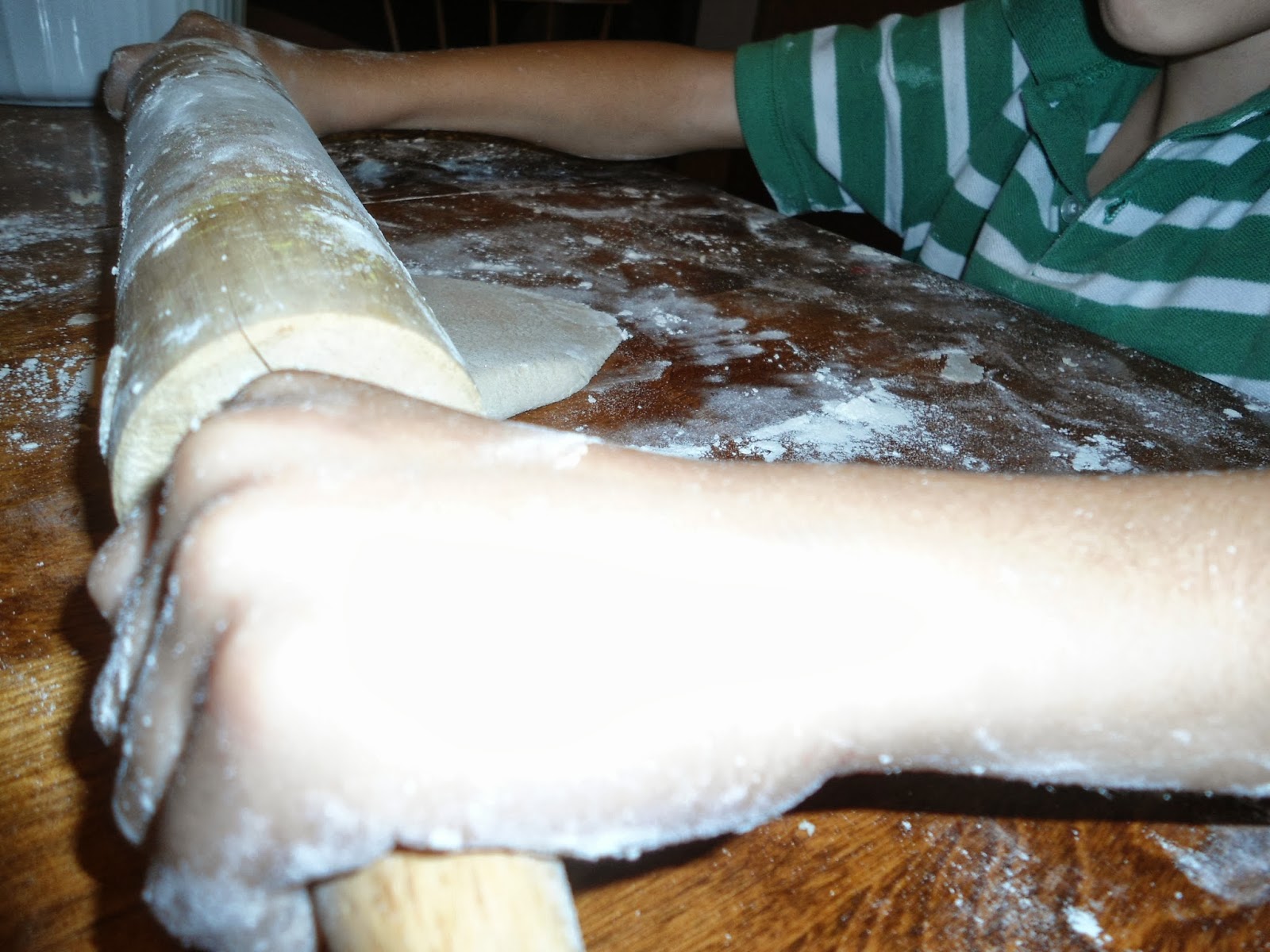
Rolling out the dough.

Carving messages.


Then we baked the tablets to harden them.

We read about ancient Egyptians who used reed to make papyrus. Without reed around, we substituted with strips of paper.
Dipping the paper strip in the flour-and-water mixture.

Laying the strips evenly.

He loved dunking his fingers in the goo.

Afterward we smashed blueberries to make blueberry ink.

I don't have pictures, but we waited for the papyrus to dry and wrote on it using the blueberry ink. The writing was very light at first, but once it dried it was a solid blue-red color. We noted that the papyrus seemed pretty fragile and the coloring could easily be washed away if it water got on it. Cuneiform tablets, though heavier and harder to make, were much more resistant to destruction.

We also constructed our own Nile River. We put dirt in a large pan and divided it down the middle for the river. We lay aluminum foil on the bottom and used rocks to keep it down.

We planted grass seeds along the banks, and Aidyn flooded the Nile.
Again, no pictures, but now our Nile has grass sprouted on either side of it!

World Religions/Mythologies

We read about Osiris and many other Egyptian gods. We also watched some Christian mythologies, The Prince of Egypt and Joseph, King of Dreams.

Prince of Egypt trailer

Joseph, King of Dreams trailer

He watched them both a few times and absolutely loved The Prince of Egypt.

(Gross) Science Experiment:

We peeled and carved seven apples to represent mummies and set them in different variations of preservatives to see which would last the longest. We got busy around this time, so the poor apple-heads were sitting pretty for two weeks.

Isn't he gorgeous?

Not so bad.

He's seen better days.

He was our most eligible apple--a 50/50 mix of epsom salt and table salt did wonders for his skin.

Speaks for itself.

Overall, this was a pretty gross but entertaining (and educational!) little experiment. (excuse the boxes in the background; we're in the process of moving.)

We had a blast learning about ancient Egypt!

We just started a Kindness Project unit study, so check back to see what we do!


Sunday, September 1, 2013

Why I Don't Homeschool...

Reasons Why I Do Not Homeschool:

1. I do not homeschool to impart my religious beliefs on my son, though many homeschoolers do (I'm looking at you, Duggars) and they should be free to do so; I homeschool to give my son a secular view, to help him find his own answers to the great question of the universe rather than burdening him with my own.

2. I do not homeschool to cripple his socialization (though so, so many people target that stereotype); I homeschool to socialize him well, to see beyond the exclusivity of his peers' approval and limited views, to converse with people of all ages, backgrounds, creeds, and beliefs. I do not think he "needs" to be surrounded by others who are EXACTLY the same age as he. Where else does that happen?

3. I do not homeschool because I hate teachers; I love teachers, but I feel like they are given too little power in their own classrooms. If they were given more freedom and resources, public school wouldn't be such a terrible option for us.

4. I do not homeschool because I believe everyone should homeschool; every involved parent "homeschools" to some degree. To wrest control from the government over a child's education is just not possible for many people. We have been raised to believe that public school is normal but disregard the downward spiral of academic achievement, school violence, overcrowdedness, and the suffocation of ridiculous peer pressure.

5. I do not homeschool to teach him the way I want him to be taught; I homeschool to discover how he learns best so that I might use this time wisely and help him learn effectively. I don't believe that he (or a great many people) learns by sitting passively, by jamming a bunch of information in his head on a week-by-week basis in order to pass some standardized test (that won't benefit him anyways), or by wasting his time pretending to be interested in whatever is going on in the classroom. I homeschool to have one-on-one Socratic discussions with him, to let him speak his own thoughts and wrangle out his own logic, to let him explore freely and find his own interests.

6. I do not homeschool to reenact some terrible, stereotypical Nurse Ratched role (the most ignorant and asinine comment I received was this lovely remark); I homeschool to continue a loving and supportive relationship with my child.

7. I do not homeschool to create some "weird-speaking" child; I homeschool to help him escape the mindless conformity of his peers, who to me can sound quite weird ("Omigawd, I LOVE Miley Cyrus, LOL, hahaha, omg."), if they fall victim to it. I want him to have an authentic interest in the things that appeal to him and to embrace his Nerdom (embrace of things he loves).

8. I do not homeschool to rebel; if he were enrolled in public school, my rebellions would be more apparent: fighting the bad influence of peers, fighting the bullying, fighting the treatment of my son as just another sheep in the flock, fighting the ridiculous rules and regulations (no gun gestures with your hands, or you're expelled!), fighting, fighting, fighting. If parents are involved with their public school kids, there would be a good deal of fighting with the school, and I am not up for that.

9. I do not homeschool because I am "better" than public school teachers; I homeschool because I know my child best and have the best intentions for his education. Public school teachers work their asses off, are underpaid and underappreciated. If they could, they would care about every single child, but sometimes there are too many students, too much acting out, and too little time to see that quiet child who might need more.

10. I do not homeschool to bogart my child or cover him in bubble-wrap: I homeschool to take him OUT into the world rather than keeping him all wrapped up in a brick-and-mortar facility in which they sometimes treat students as budding criminals. I push him to try new things out there, to hike up a mountain, spelunk in a cave, to talk to strangers (gasp!), to use a knife appropriately (instead of being disciplined in the principal's office for carrying fingernail clippers that JUST MIGHT BE A WEAPON). And though I love spending time with him, he isn't a perfect child by any means. Where we live, he plays outside for the majority of the day with kids of all ages and talks with the older ladies in the neighborhood who just love the heck out of him.

11. I do not homeschool because it's "easy" to "stay home in pajamas all day and eat bon-bons" all day; I homeschool because the work is worth it. It's never easy hearing snide comments, answering the socialization question for the bajillionth time, and suppressing the laughter from truly ridiculous comments (Ok, the last one is pretty fun). It's not easy pulling together curricula that best suits an individual person, teaching it in a way that reaches that individual person, and squelching all those old ideas about what schooling should look like. Parenting isn't easy, unless every aspect of it is outsourced.

13. I do not homeschool to hurt your feelings, put you down, or criticize the way you do things; every single friend I have who is a parent is doing exactly what they should for their children, and I am proud to have such friends. Some have harder roads than me to traverse, and they handle their specific circumstances with determination, resolve and the dedication to their children in primary view.

14. I do not homeschool because I am the Saint of Neverending Patience, though I wish she or he would gift me with extraordinary patience at times; I homeschool because I simply care about my child's education. I have just as much patience as the average parent, which is usually not much. It's a continuous reminder to breathe a little, relax, and let it be. I just try to remember that the days (and lessons) are long, but the years are oh, so short.

 15. I do not homeschool to displease you; I homeschool because it pleases us in the way we want to live, with freedom, fun and enjoyment of this one life we have.

Friday, August 30, 2013

Second Grade: Weeks Two and Three

I don't know what happened, but this year feels dramatically different than last year. Not that he protested and sobbed his eyes out last year, but there was a certain resistance at times. This year, he is plugged in 100%, super comfortable, taking the time to think ideas through instead of just asking for the right answer, and seems much more confident.

I don't know if it's because this is our second year (despite hs'ing through preschool), the new math curriculum, or what.

Math:

We are continuing our work with Saxon, and he continues to love it. I find it a little repetitive, but the constant review is helping him master math facts. Each morning, we check the weather and fill in a weather graph.


We look at a birthday graph and ask each other questions about it, count forwards and backwards on the numbers chart, practice telling time, announce the day of the week and the month and write the date, practice doubles facts, and play with pattern shapes.

He breezes through the lesson and often lingers at the table during break and plays with pattern blocks or dominoes.


Phonics/Grammar/Handwriting/Reading:

Aidyn's plowing through Sadlier Phonics and was able to handle the assigned pages on days I was at school and he worked independently. I've also noticed that he's picked up many sight words (about, could, opposite, what, your, etc.) that we haven't formally learned. Although his reading is getting better, he still prefers to read his easy-peasy phonics books rather than library books. But he's the sort of guy that wants to feel mastery over the subject and will purposefully do things that are easy for him.


We're still satisfying my ever-loving grammar soul working on grammar and have learned more about punctuation, capitalization rules, suffixes, and sentence-combining.

He still writes like Dr. Aidyn, but we're working on his handwriting still.

And of course, we played Nerf Gun Target Practice  to help him review some vocabulary words.


This 'n' That:


  • We're putting higher expectations on his reading speed. Our goal is 50 wpm on each page (with the end of 2nd grade goal of 55wpm). He's done page 1 and 2, repeating each twice, but yesterday just before the 3rd round of reading, he declared, "I can't make 50." We talked a bit about thinking positively, saying that you can do something and then doing your best. On the 3rd round, he read 51 wpm.
  • His oral vocabulary and the cadence with which he speaks surprises me sometimes. In conversations, he used the words "amount," "filthy," "nomads," and "worry-wort" among others.

Science:

We are still reading from The Usbourne First Encyclopedia of Our World and have learned about the composition of the moon (which we didn't get much into because the second half of the year will focus on astronomy), day and night cycles, and total eclipses.

History:

We're enjoying Story of the World and learning about nomads becoming the first farmers. Yesterday, we attempted to build two shadufs, as illustrated in our book. A shaduf is an early irrigation farming tool used to bring water from the canals to the land above it. It seemed like such a simple machine that we could certainly build a replica. It was most certainly a learn-as-you-go experience.

(excuse the clothing; he was ninja that day)


Stabilizing it was a challenge. Next time we're using play dough!


We attached another pole to the frame with pipe cleaners and attached a bottle cap to the end of the pole.


I put out two bowls (one with water and the other with flour) to simulate both the water source and the land. I told him that he could not touch the water with his hands, but once he delivered the bucket to land, he could empty it, the goal being to irrigate the land.


It worked! I never had a shaduf of a doubt.

In other history fun, we've been reading the mammoth novel The Red Pyramid by Rick Riordan. 


Although it's a beast to read, the story is pretty epic. There's all kinds of crazy things going on--treasure-hunting, magic, transformations, crazy guys in trench coats, hieroglyphics, Osiris appearing (and disappearing), crazy guys turning into serpents, etc., and we're not even halfway through it!

We haven't reached the Egyptian section of SOTW just yet, but it's around the corner! Aidyn also watched "Kids Animated History with Pipo: Ancient Egypt" for free on Hulu. (link will take you to Hulu)

Memory work:

Last week, we worked on memorizing the order of the planets, and Aidyn had 'em down on day 2. Nevertheless, we practiced every day, drew pictures of their position to the sun, and did copywork of the planet names. On that Friday, he "performed" it for everyone.

This week, we have worked on counting from 1-10 in Latin. I'm trying to throw in some Latin words and phrases here and there because the plan is to teach Latin as a foreign language in 3rd grade. Recently Aidyn has been requesting to learn French, but I told him that learning Latin will make learning French (and Spanish, Portuguese, Italian, and Sicilian, among many others) a million times easier.

As far as counting, he has trouble remembering to start with "unus" and still pronounces "novem" and "decem" like the months, but we're working on it. He can perform it if practice is fresh but cannot after some time, so we are going to continue with this piece for next week.

In Other Thoughts:

I don't know about Aidyn, but I'm getting tired of the 3Rs from the books. I feel like a fun unit study would be good right about now. I've been brainstorming ideas for an Ancient Egypt unit study, complete with pyramid buidlin', Egyptian mythology readin', and documentaries galore. Check back soon to see what we do!

Wednesday, August 21, 2013

Vocabulary Word Target Practice with Nerf Guns

So we've had our sights on vocabulary words, so to speak. Let me explain.

Over the past six months, my little guy has become obsessed with Nerf Guns. He has a stash of about seven (maybe one of which we have bought him and many that he has traded for or bought himself with his allowance). He and his friends play with Nerf Guns practically every day and talk their crazy Nerf lingo that I barely understand.

I know some people get all uppity about toy guns. We've had people criticize us for it before (despite Aidyn being a super sweet guy who doesn't use Nerf Guns to hurt people or animals or even to pretend to do so). So, if you are of the opinion that "toy guns are evil," you might want to hit the little X in the corner of your screen so that I don't accidentally sway you with a different opinion.

Let me clarify that we don't hand Aidyn toy guns and say, "Have at it, kid!"

We don't do that with anything. There is an ongoing conversation about his interests, things he's exposed to in life, on television, with friends, with family members, with society, with his emotions, etc. because we want to help him establish his own moral compass rather than helicoptering all over him and dictating his interests.

If you're on the fence about it, check out this PBS article about boys and guns.

As I dismount my little soapbox, let me show you this game we made up to combine the Love O' Nerf and Reading. I set up several word cards on the closet doors (any flat surface would do).


Right in the middle of doing school, I very seriously told Aidyn that now I needed him to "pick out [his] best Nerf Gun and make sure it's loaded." He was like one of those cartoons characters that leaves a cloud of dust when they take off fast.

First, he read the words posted in front of him. Some were in the middle, some down low, and some super high. I used a stopwatch to time his target practice, announced a word, and he scrambled to find and shoot it as quickly as possible.


The first round, he scored:


  • 5 words per minute
  • 5 words per minute
  • 7 words per minute
Then I added more vocabulary cards and he got:

  • 4 words per minute
  • 5 words per minute
  • 4 words per minute
The next day I added even more cards, but his scores remained about the same.


I foresee that we will play this game for the rest of our lives  the school year. It has just occurred to me that a game like this could get him suspended from public school, even if he only used a hand gesture to simulate a gun...Reason #324 to homeschool!