Showing posts with label YouTube resources. Show all posts

Thursday, January 15, 2015

What Does the Fox Say? Unit Study


By now, most people are familiar with the hit song "The Fox (What Does the Fox Say?)" by Norwegian artist Ylvis, who went viral when his video debuted in 2013.

And if not, have a listen.


Aidyn loved it at first listen and has since played the song a gajillion times and even recorded his own lip-syncing video of "What Does the Fox Say?". And like any good homeschooling parent, when my child is obsessed with something, I turn it into a unit study. Ha, ha.

I scoured the internet for a pre-made WDtFS unit study and only found cutesy ones for younger children, so I scraped some ideas together and created a fun, age-appropriate study for Aidyn.

Language Arts: Introduction to Satire

In case you weren't aware, Ylvis released a children's book based on his YouTube viral video, but recreating all the silly fox sounds rests all on your shoulders.

So I asked Aidyn to read it to me.


We talked about how goofy the song and the lyrics are...


...and that the song is a satire of pop songs with insanely stupid lyrics somehow topping the charts. I gave Aidyn a very simple definition of satire: something that makes fun of something else to make a point. In this case, it's a song that makes fun of other popular songs to prove that society gravitates toward silly songs based on how catchy they are.

For fun, we read other children's satires like:


The True Story of the 3 Little Pigs is a fractured fairy tale of "The Three Little Pigs." Author Jon Scieszka could be satirizing victim mentality, as the wolf blames his harmless cold and the pigs' rudeness for their own demise. Aidyn loved hearing the other side of this familiar story.

We also read another of Scieszka's books, The Stinky Cheese Man and other Fairly Stupid Tales.


Now this is a FUN read. Familiar fairy tales are not only distorted but laugh-out-loud funny to read. 


We also watched Spaceballs because it's hilarious and why not?  to learn more about satire and parody.


Language Arts: Read-Alouds:

We read more serious fox stories like Red Fox Running by Eve Bunting.


Wendell Minor's paintings in the book are truly beautiful. 


We also read a chapter book called Ereth's Birthday (by Avi), a poignant story of a grumpy porcupine who cares for three fox kits when their mother dies.


Language Arts/Vocabulary: Morse

"But if you meet a friendly horse, will you communicate by Morse?"

Aidyn wasn't sure what "morse" meant, so we read Radio Rescue by Lynne Barasch. The story follows a young boy who, at the age of 10, became the youngest licensed amateur wireless radio operator in 1923. 

In a world of tablets, smart phones, and computers, we don't usually hear about Morse code and "ham" radios, but Aidyn found it fascinating.

He even practiced "tapping" his name in Morse code with a guide at the back of the book.


Social Studies/Geography: Norway

Because Ylvis is Norwegian, we learned a bit about Norway with this book:


We talked about the geography of Norway, its mountains and fjords, the weather, its rich history and royal family, the Sami ethic group that lives there, the food, and their languages. Aidyn was especially interested in the Sami people and did some copywork about them.


Science: Fox study and What Do Foxes Really Say?

We used Foxes  by Sandra Markle to learn about foxes.


Aidyn picked his favorite fox fact for copywork.


He worked on handwriting with fox facts.


And then, we answered the question: what do foxes really say?


We learned that foxes actually make a lot of different sounds from barks to purrs, mating calls, and gekkering. Aidyn busted a gut when we heard a fox "scream" in the video.

Art: Drawing foxes


We spent an afternoon learning to draw foxes with the help of a couple YouTube videos:


Makin' Memories: Baking fox food (aka Blueberry Muffins)

In our studies, we learned that foxes love eating berries, so we made some yummy blueberry muffins. 


Even Jack got in on the fox fun--even if all he did was dress up!


We had a blast turning Ylvis's song into a fun and foxy unit study! We're guaranteed to remember all we did whenever we hear that silly song (which I'm sure will be at least 547 times a week until Aidyn finds something else to annoy me with  share with me!) 


Tuesday, February 4, 2014

The History of Animation and Film Unit Study: Part Three

This unit study is inspired by Walt Disney World's park Disney's Hollywood Studio. We have never been to Disney World but are playing with the idea of a 2015 vacation there. Our unit studies are our fun and educational way to build excitement for that adventure.

In Part One, we explored the earliest experiments with both film and animation and we made our own zoetrope. In Part Two, we focused on films and filmmakers of the early 20th century, including Georges Melies, Mack Sennett and Charlie Chaplin. We also toured the Disney Animation building at Disney California Adventures.

Last week, we focused on film and animation in the 1920s, which was a booming time for the industry with the popularity of Charlie Chaplin and the creation of Mickey Mouse in "Plane Crazy."

This is a media-heavy unit study. I created a playlist of important film/cartoon shorts of the period. After we finished with our core school work, Aidyn and I snuggled on the couch and watched the videos. I introduced each with a snippet of history, but mostly I encouraged him to reach his own conclusions and to compare/contrast what he was viewing.

~The 1920s~

Below is the playlist we watched together:

1920s Cartoon and Film Playlist


  • Felix the Cat Saves the Day (1922) (which brought up a discussion of the use of blackface in early entertainment)
  • Puss in Boots~ Walt Disney's Laugh-O-Grams (1922)
  • Walt Disney's The Four Musicians of Bremen (1922)
  • Walt Disney's Little Red Riding Hood (1922)
  • Walt Disney's Oswald the Lucky Rabbit in "Trolley Troubles" (1926)
  • Walt Disney's Oswald the Lucky Rabbit in "Great Guns!" (1927)
  • Walt Disney's Oswald the Lucky Rabbit in "Oh, What a Knight"
  • Oswald the Lucky Rabbit in "Permanent Wave (1929)
  • Mickey Mouse in "Plane Crazy" (1928) (first Mickey Mouse cartoon)
  • Mickey Mouse in "Steamboat Willie" (1928) (first cartoon with synchronized sound)
  • Mickey Mouse in "The Opry House" (1929)
  • Mickey Mouse in "The Barn Dance" (1929)
  • Disney's Silly Symphonies "The Skeleton Dance" (1929) (the first Silly Symphony)
We're making a scrapbook-inspired timeline as we watch:


We also watched Charlie Chaplin's The Kid (1921) (Chaplin's first full-length feature film)


This movie is both hilarious and heart-wrenching. It inspired a range of discussion not only about film but about the human condition.


And Harold Lloyd in Safety Last! with the iconic clock scene.


 ~The 1930s~

1930s Cartoon Playlist

I tried to pick cartoon shorts with significance to the history of animation, but I also included a few fun cartoons. This list can easily be shortened or expanded.

  • "Summer"~ Silly Symphony (1930)
  • "Midnight in a Toy Shop"~ Silly Symphony (1930)
  • "Mickey's Orphans" (1930) (nominated for the Academy Award for Best Animated Short in 1932 but lost to Disney's other cartoon "Flowers and Trees.")
  • "Flowers and Trees" (1932) (first commercially released film to be produced in the full-color three-strip Technicolor process. Won the first Academy Award for Animated Short Subjects.)
  • "Parade of the Award Nominees" (1932) Originally unintended for public viewing. First cartoon with Mickey Mouse in color.
  • "Building a Building" (1933)
  • "The Wise Little Hen" (1934) First debut of Donald Duck.
  • Popeye, circa 1930s
  • Betty Boop in "I Heard" (1933)
  • Mickey Mouse in "Gulliver Mickey" (1934) Inspired by Gulliver's Travels
  • "The Tortoise and the Hare"~ Silly Symphony (1935) 
  • "Three Orphan Kittens"~ Silly Symphonies (1935)  Won Academy Award for Best Short Subject (Cartoon) in 1935. Contains use of racial stereotype that could prompt discussion.
  • Mickey Mouse in "Thru the Mirror" (1936) Inspired by Alice through the Looking Glass.
  • "The Old Mill"~ Silly Symphonies (1937) First use of Disney's multiplane camera, later used with Snow White and the Seven Dwarfs. Won 1937 Academy Award for Best Short Subjects: Cartoon.
  • "Ferdinand the Bull" (1938) Inspired by book of the same title.
  • Mickey Mouse in "The Pointer" (1939)

1930s timeline:


We learned how Walt Disney created Mickey Mouse:


We learned about the animation process in the 1930s from a Paramount newsreel:


The Invention of Hugo Cabret

We finished reading Brian Selznick's amazing book, The Invention of Hugo Cabret, which beautifully weaved our entire unit study (thus far) together. The story takes place in a Paris railway station in the 1930s. Hugo Cabret, orphan and clock keeper,  also keeps secrets, but a meeting with an eccentric old toy tinkerer and his goddaughter allows him to reveal his deep need for human connection and the realization of his purpose. This book is not exactly a novel any more than it is a picture book or graphic novel. Whatever it is, it's poignant and dream-like.

We hosted an intimate Family Movie Night last Friday and watched the film, Hugo, which also married many of the things we learned about during our unit study like Georges Melies and his early films, clips of Harold Lloyd in Safety Last!, the first on-screen kiss, Charlie Chaplin in The Kid, and other early films like "Train Pulling into the Station."

Hugo movie trailer:

First Full-Length Animated Feature: Snow White and the Seven Dwarfs~

We concluded the 30s by learning about the first full-length animated feature. We learned that most people thought Walt Disney was foolish to embark on this venture to make a movie out of a cartoon. He nearly bankrupted their business without even knowing if their movie would succeed. 

The One That Started It All: Snow White and the Seven Dwarfs, Part One.


Part Two

We watched a video from the bonus features DVD about the voice talents and animation from Snow White and the Seven Dwarfs before Aidyn couldn't take it anymore and HAD to watch the film. We snuggled up and watched, remarking here and there what might have happened had Walt listened to his naysayers and gave up on his dream to make the first animated movie.


Well, that's all for the 20s and 30s! But we are continuing our film and animation unit study through the 40s this week (and possibly back-pedaling to look into The Wizard of Oz). Check back for more!


Monday, January 6, 2014

The History of Animation and Film Unit Study: Part One

Our family is still playing around with the dream completely realistic goal of going to Walt Disney World in the near future (i.e., before I die), and Aidyn's been intrigued by animation lately. I decided (for the heck of it) to take us on a Disney World-inspired unit study adventure.

First stop, according to Aidyn: Disney's Hollywood Studios, so we can learn about animation.

Got it.

Little did I realize how challenging it is to find anything remotely "academic" in the realm of animation. Then I knew I was kidding myself. We are homeschooling, after all. We can learn any way we like!

So here's what we did:

I made a timeline, from roughly 1820 to the present. I printed blank timeline sheets (TL-5) from donnayoung.org, and sectioned each page to accommodate a decade. I pinned them on the wall before starting and printed up some pictures of Aidyn, his dad and me, and his grandma to plot on our birth years for reference.

Pinning his own picture to 2005

Mama and Daddy in the early '80s

And Grandma in '44

Prior to the lesson, I printed small pictures of important moments in animation history including:

-the invention of the thaumatrope, phenakistoscope, zoetrope, and praxinoscope
-creation of "The Humorous Phases of Funny Faces," "Gertie the Dinosaur," "Colonel Heeza Liar," and Felix the Cat from 1919
(I basically borrowed them online. Thank you, Google Images!)

Together we watched "The Story of Animation" on YouTube and placed new pictures on the timeline along the way.


We talked and joked about how primitive early animation was and how one invention slowly led to another.


Afterward, we brainstormed  our impressions of early animation from 1820 to 1919. He described how they looked and characters he liked as I transcribed it. I also asked him to write one interesting thing and a question he still had. He wrote that he liked Gertie the Dinosaur and how she threw the woolly mammoth in the lake. He wondered (a little ahead of time, since we haven't covered this yet) how Walt Disney lost Oswald the Lucky Rabbit.

We both observed the violence in early cartoons but admit to laughing at them. I explained slapstick comedy to him, and he remembered The Three Stooges.


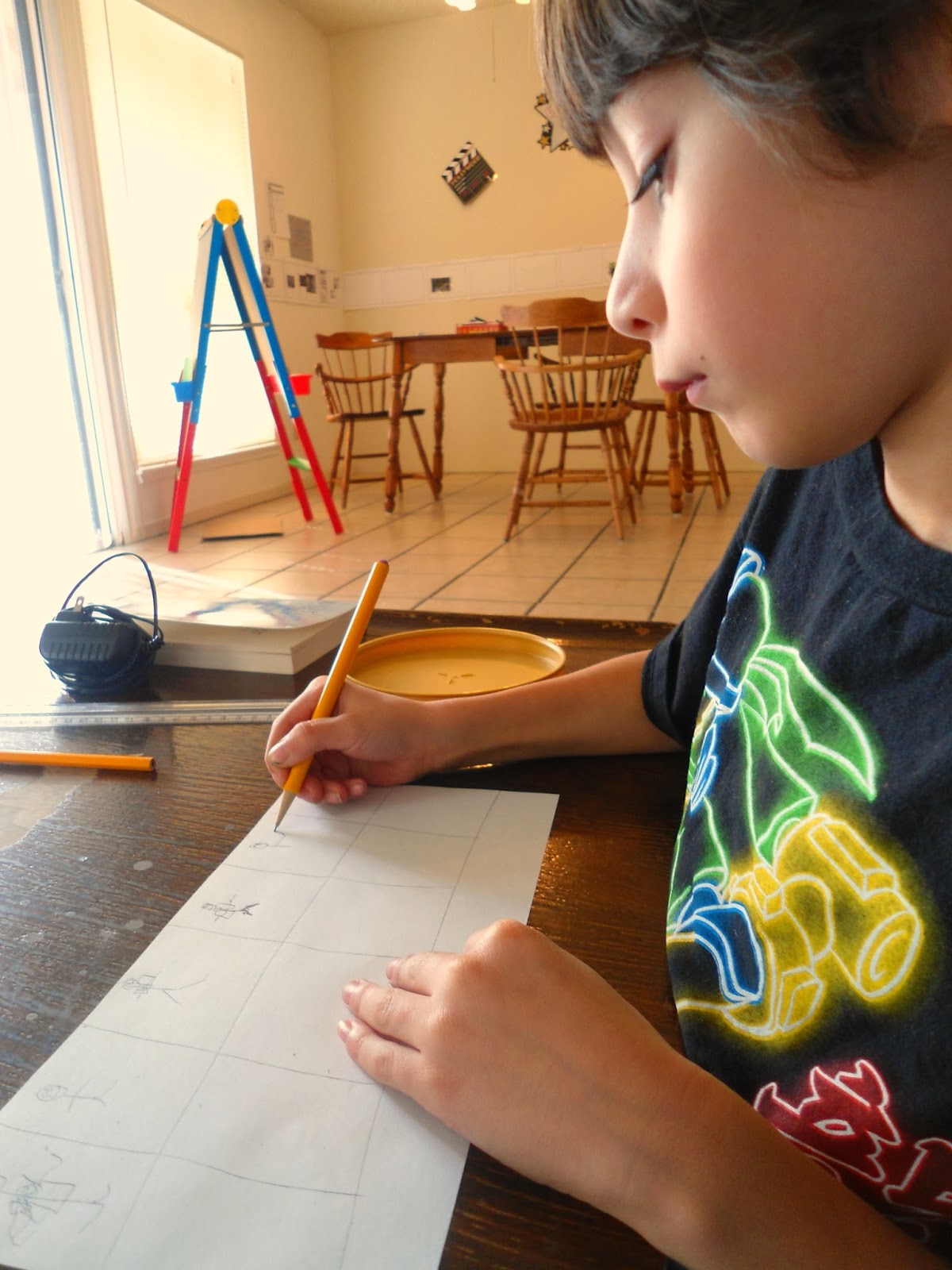
We also made a zoetrope. I remember making one in 7th grade (I had a cool music/animation teacher somehow), so I figured it wouldn't be too hard.

Just in case, we watched this how-to video a dozen times:


Aidyn practicing some sketches.

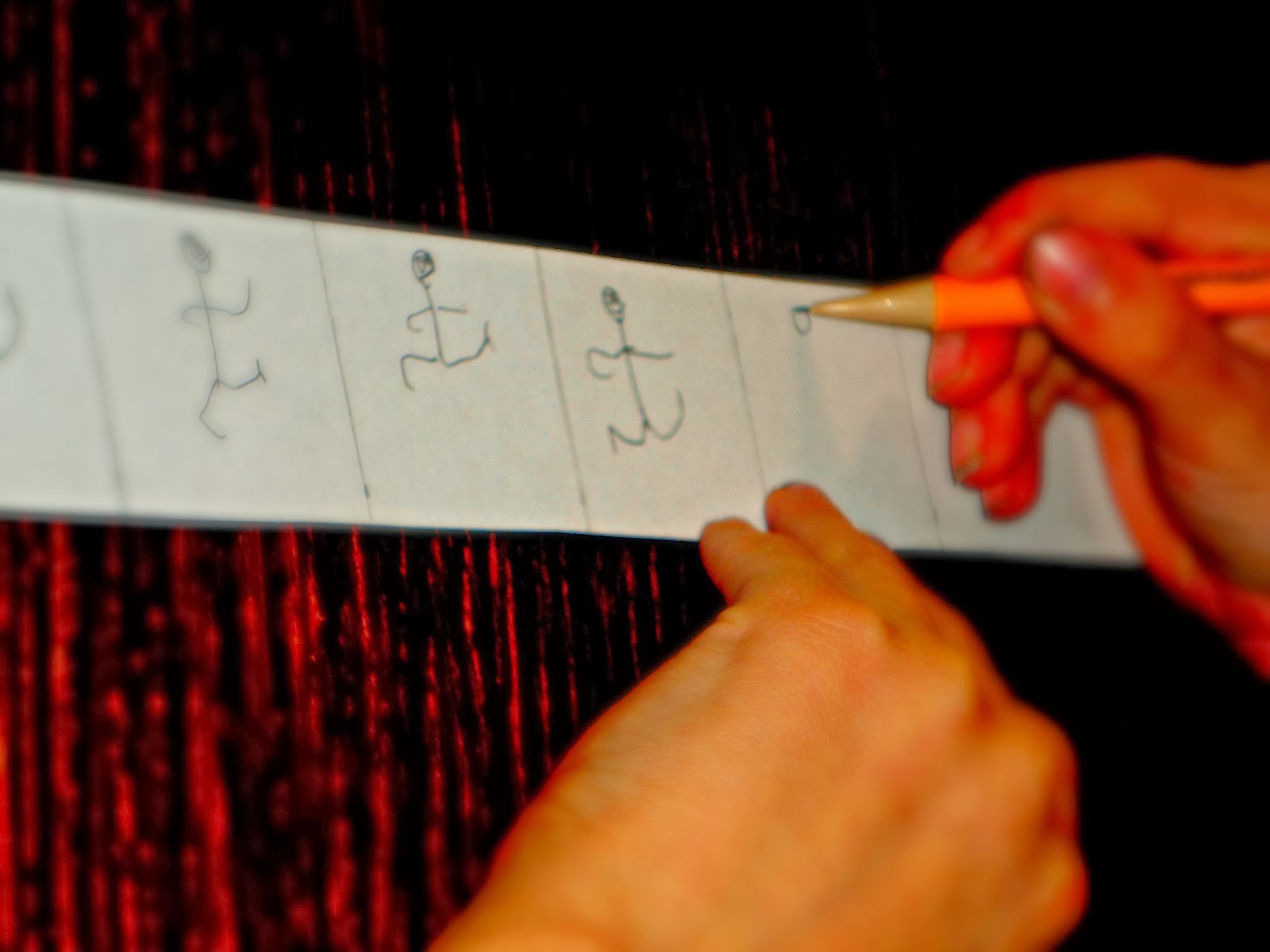
Drawing animation on the cels. 

"A guy running," he says.

Spin!

I'm pretty sure he will appreciate television and instant cartoon availability much more now...

We still have a far way to go. Next time, we'll be learning about the history of film and tracing both animation and film through the decades. 


Check back to see what we do!