Showing posts with label interactive movie viewing. Show all posts

Tuesday, February 4, 2014

The History of Animation and Film Unit Study: Part Three

This unit study is inspired by Walt Disney World's park Disney's Hollywood Studio. We have never been to Disney World but are playing with the idea of a 2015 vacation there. Our unit studies are our fun and educational way to build excitement for that adventure.

In Part One, we explored the earliest experiments with both film and animation and we made our own zoetrope. In Part Two, we focused on films and filmmakers of the early 20th century, including Georges Melies, Mack Sennett and Charlie Chaplin. We also toured the Disney Animation building at Disney California Adventures.

Last week, we focused on film and animation in the 1920s, which was a booming time for the industry with the popularity of Charlie Chaplin and the creation of Mickey Mouse in "Plane Crazy."

This is a media-heavy unit study. I created a playlist of important film/cartoon shorts of the period. After we finished with our core school work, Aidyn and I snuggled on the couch and watched the videos. I introduced each with a snippet of history, but mostly I encouraged him to reach his own conclusions and to compare/contrast what he was viewing.

~The 1920s~

Below is the playlist we watched together:

1920s Cartoon and Film Playlist


  • Felix the Cat Saves the Day (1922) (which brought up a discussion of the use of blackface in early entertainment)
  • Puss in Boots~ Walt Disney's Laugh-O-Grams (1922)
  • Walt Disney's The Four Musicians of Bremen (1922)
  • Walt Disney's Little Red Riding Hood (1922)
  • Walt Disney's Oswald the Lucky Rabbit in "Trolley Troubles" (1926)
  • Walt Disney's Oswald the Lucky Rabbit in "Great Guns!" (1927)
  • Walt Disney's Oswald the Lucky Rabbit in "Oh, What a Knight"
  • Oswald the Lucky Rabbit in "Permanent Wave (1929)
  • Mickey Mouse in "Plane Crazy" (1928) (first Mickey Mouse cartoon)
  • Mickey Mouse in "Steamboat Willie" (1928) (first cartoon with synchronized sound)
  • Mickey Mouse in "The Opry House" (1929)
  • Mickey Mouse in "The Barn Dance" (1929)
  • Disney's Silly Symphonies "The Skeleton Dance" (1929) (the first Silly Symphony)
We're making a scrapbook-inspired timeline as we watch:


We also watched Charlie Chaplin's The Kid (1921) (Chaplin's first full-length feature film)


This movie is both hilarious and heart-wrenching. It inspired a range of discussion not only about film but about the human condition.


And Harold Lloyd in Safety Last! with the iconic clock scene.


 ~The 1930s~

1930s Cartoon Playlist

I tried to pick cartoon shorts with significance to the history of animation, but I also included a few fun cartoons. This list can easily be shortened or expanded.

  • "Summer"~ Silly Symphony (1930)
  • "Midnight in a Toy Shop"~ Silly Symphony (1930)
  • "Mickey's Orphans" (1930) (nominated for the Academy Award for Best Animated Short in 1932 but lost to Disney's other cartoon "Flowers and Trees.")
  • "Flowers and Trees" (1932) (first commercially released film to be produced in the full-color three-strip Technicolor process. Won the first Academy Award for Animated Short Subjects.)
  • "Parade of the Award Nominees" (1932) Originally unintended for public viewing. First cartoon with Mickey Mouse in color.
  • "Building a Building" (1933)
  • "The Wise Little Hen" (1934) First debut of Donald Duck.
  • Popeye, circa 1930s
  • Betty Boop in "I Heard" (1933)
  • Mickey Mouse in "Gulliver Mickey" (1934) Inspired by Gulliver's Travels
  • "The Tortoise and the Hare"~ Silly Symphony (1935) 
  • "Three Orphan Kittens"~ Silly Symphonies (1935)  Won Academy Award for Best Short Subject (Cartoon) in 1935. Contains use of racial stereotype that could prompt discussion.
  • Mickey Mouse in "Thru the Mirror" (1936) Inspired by Alice through the Looking Glass.
  • "The Old Mill"~ Silly Symphonies (1937) First use of Disney's multiplane camera, later used with Snow White and the Seven Dwarfs. Won 1937 Academy Award for Best Short Subjects: Cartoon.
  • "Ferdinand the Bull" (1938) Inspired by book of the same title.
  • Mickey Mouse in "The Pointer" (1939)

1930s timeline:


We learned how Walt Disney created Mickey Mouse:


We learned about the animation process in the 1930s from a Paramount newsreel:


The Invention of Hugo Cabret

We finished reading Brian Selznick's amazing book, The Invention of Hugo Cabret, which beautifully weaved our entire unit study (thus far) together. The story takes place in a Paris railway station in the 1930s. Hugo Cabret, orphan and clock keeper,  also keeps secrets, but a meeting with an eccentric old toy tinkerer and his goddaughter allows him to reveal his deep need for human connection and the realization of his purpose. This book is not exactly a novel any more than it is a picture book or graphic novel. Whatever it is, it's poignant and dream-like.

We hosted an intimate Family Movie Night last Friday and watched the film, Hugo, which also married many of the things we learned about during our unit study like Georges Melies and his early films, clips of Harold Lloyd in Safety Last!, the first on-screen kiss, Charlie Chaplin in The Kid, and other early films like "Train Pulling into the Station."

Hugo movie trailer:

First Full-Length Animated Feature: Snow White and the Seven Dwarfs~

We concluded the 30s by learning about the first full-length animated feature. We learned that most people thought Walt Disney was foolish to embark on this venture to make a movie out of a cartoon. He nearly bankrupted their business without even knowing if their movie would succeed. 

The One That Started It All: Snow White and the Seven Dwarfs, Part One.


Part Two

We watched a video from the bonus features DVD about the voice talents and animation from Snow White and the Seven Dwarfs before Aidyn couldn't take it anymore and HAD to watch the film. We snuggled up and watched, remarking here and there what might have happened had Walt listened to his naysayers and gave up on his dream to make the first animated movie.


Well, that's all for the 20s and 30s! But we are continuing our film and animation unit study through the 40s this week (and possibly back-pedaling to look into The Wizard of Oz). Check back for more!


Monday, September 23, 2013

Ancient Egypt Unit Study

The breadth of this unit study lasted close to three weeks, so I will try to remember everything we did!

Geography:

We learned about the geography of Egypt and created a simple map. We learned that the Nile River flows northward and splits off into a delta.

Painting the Red Sea

Painting Egypt

Finished piece

Writing:

We learned about many different ancient Egyptian gods, and Aidyn created his own god: a half-tiger, half-man god.

We learned all about pyramids and what was stored in them.

Reading:
For fun, we read Who's Your Mummy? by R.L. Stine

And Bill and Pete Go Down the Nile by Tomie dePaola

And the hilarious Skippy Jon Jones in Mummy Trouble by Judy Schachner.

Aidyn also learned to read some Egyptian words.

Hands-on Learning/Art:

We made hieroglyph stamps using potatoes. 


We read about how the early Mesopotamians  made cuneiform tablets while the Egyptians made papyrus. We made both to see which was easier to make and which was most durable.

Mixing the batter for cuneiform tablets.

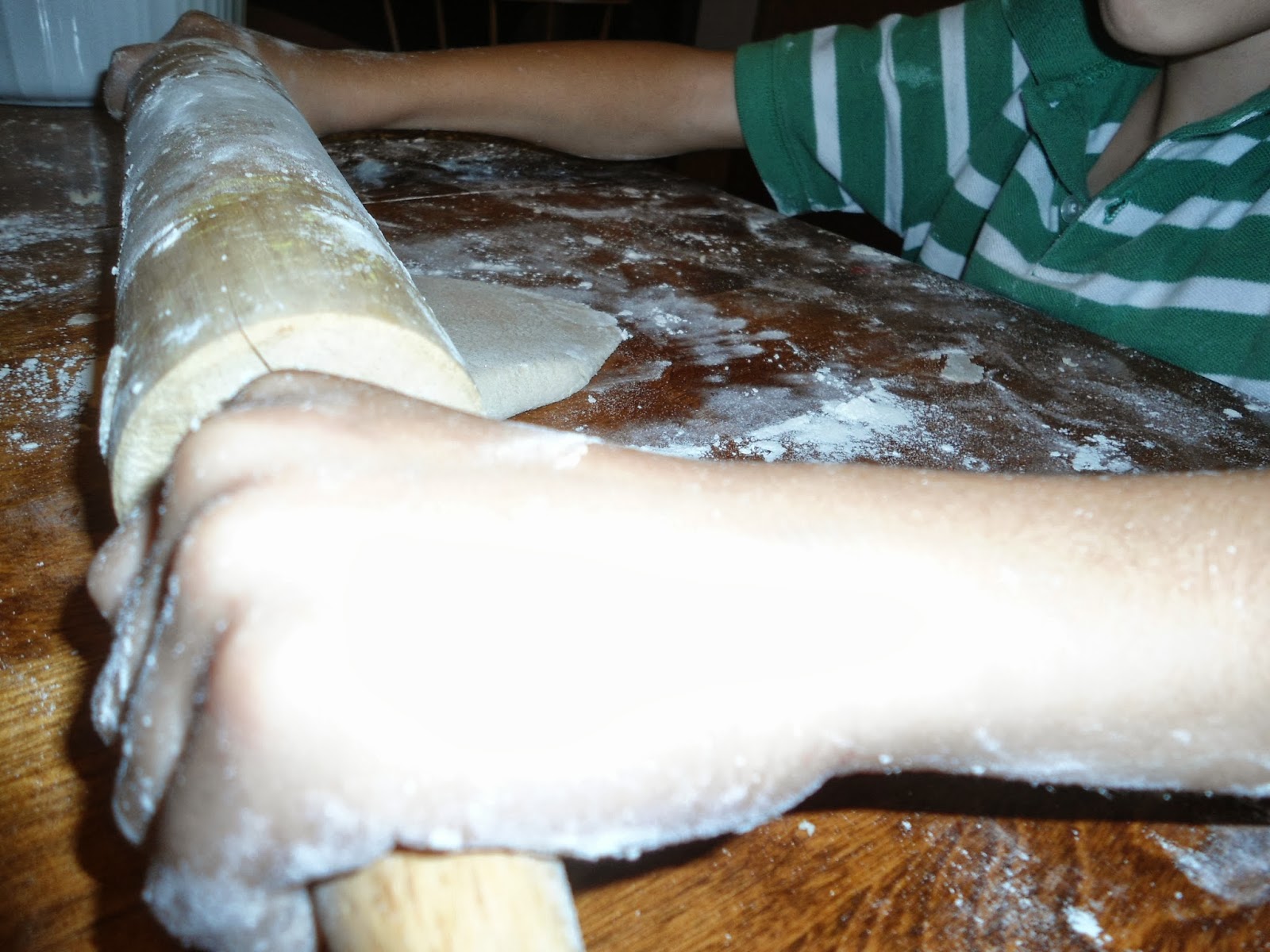
Rolling out the dough.

Carving messages.


Then we baked the tablets to harden them.

We read about ancient Egyptians who used reed to make papyrus. Without reed around, we substituted with strips of paper.
Dipping the paper strip in the flour-and-water mixture.

Laying the strips evenly.

He loved dunking his fingers in the goo.

Afterward we smashed blueberries to make blueberry ink.

I don't have pictures, but we waited for the papyrus to dry and wrote on it using the blueberry ink. The writing was very light at first, but once it dried it was a solid blue-red color. We noted that the papyrus seemed pretty fragile and the coloring could easily be washed away if it water got on it. Cuneiform tablets, though heavier and harder to make, were much more resistant to destruction.

We also constructed our own Nile River. We put dirt in a large pan and divided it down the middle for the river. We lay aluminum foil on the bottom and used rocks to keep it down.

We planted grass seeds along the banks, and Aidyn flooded the Nile.
Again, no pictures, but now our Nile has grass sprouted on either side of it!

World Religions/Mythologies

We read about Osiris and many other Egyptian gods. We also watched some Christian mythologies, The Prince of Egypt and Joseph, King of Dreams.

Prince of Egypt trailer

Joseph, King of Dreams trailer

He watched them both a few times and absolutely loved The Prince of Egypt.

(Gross) Science Experiment:

We peeled and carved seven apples to represent mummies and set them in different variations of preservatives to see which would last the longest. We got busy around this time, so the poor apple-heads were sitting pretty for two weeks.

Isn't he gorgeous?

Not so bad.

He's seen better days.

He was our most eligible apple--a 50/50 mix of epsom salt and table salt did wonders for his skin.

Speaks for itself.

Overall, this was a pretty gross but entertaining (and educational!) little experiment. (excuse the boxes in the background; we're in the process of moving.)

We had a blast learning about ancient Egypt!

We just started a Kindness Project unit study, so check back to see what we do!


Friday, August 31, 2012

Prehistory and The First Dog

This week, we traveled back in time. Way back in time.

We spent a week learning about prehistoric man (and woman, and child, and even dog!) through books, videos, projects, and play-acting.

Throughout the week, we rowed The First Dog by Jan Brett. Brett is an amazing writer and illustrator so, despite this book not being available on homeschoolshare.com, it was super easy to row it.


The story is about a cave boy named Kip who finds Paleowolf following him around, sniffing and whining for his leftover Wooly Rhino Rib and  getting him out of trouble with the other dangerous animals. It's not until Paleowolf saves Kip from the Saber-Tooth Cat that he realizes that he and Paleowolf would make excellent companions.

Day #1: Art

On early Monday morning, I made a cave behind our living room couch. I cut apart paper bags, crinkled them, smoothed them out and makeshift-wallpapered them. When Aidyn woke up, he climbed around in his cave, and that is where we read our book for the first time.

 
Afterward, we cracked open Cave Paintings to Picasso,  a children's book about art. I read about the cave art discovered in Lascaux, France by four boys and their dog. As I read, Aidyn colored a picture of cave art for our timeline.


On Monday, we also watched Walking with Cavemen, a spectacular show about early man, starting with Australopithecus afarensis.


Of course, the episodes garnered many questions.
Why did they live in trees?
Why did they have so much hair?
How did they change?
How long did it take us to change like that?

He was particularly irritated that it did not show a clear metamorphosis, that it just jumped from one species to another. We consulted The Best Book of Early People to see a clearer progression of our march through time.


Day #2: Math and Science

While reading The First Dog on the second day, we counted the different illustrations of wolves, mammoths, and sabor-tooth cats. Afterward, we counted the bone beads and arrowheads we had picked up at The Bone Room In Berkeley and made patterns and letter shapes.


Aidyn also watched an episode of Bill Nye the Science Guy on evolution. Here's part one of the episode we watched:


We kept up the dialogue about cave people and read Mammoth by Patrick O'Brien.


We learned all about mammoths and that they were one of the last prehistoric creatures to die off!

We also read a chapter or two from The Magic Tree House: Sunset of the Sabretooth  each day.


Day #3: Language Arts/Poetry

On Day 3 of reading The First Dog, I asked Aidyn to keep an ear out for descriptive words. I gave him some examples, and he was able to locate others pretty quickly. We discussed the power of description, how it can help us visualize sights, scents, sounds, tastes, and feelings. We compared the two sentences:

I have some food.
I have a big bowl of steaming, hot, buttery popcorn.

He was eating a bowl of celebratory ice cream at the time so he went into a full-on description of its yummy goodness. Then we read two poems about color, "What is Pink?" by Christina Rosetti and "What is Orange?" by Mary O'Neill. After discussing them, we talked about the color brown and what it looks and feels like. The result was this dictated poem:

Brown looks like beans, a roof, worm food, and caramel.
Brown sounds like dust.
Brown feels like dirt and mud.
Brown smells like mud and poop.
Brown tastes like dirt and the "worms in mud" that my Mama makes.

Inspired by Bill Nye, we also conducted a light science experiment. In his episode, Bill Nye explained that some plants have adapted to survive practically any condition. Moss is one of those die-hard plants. We found some moss growing near our home. As instructed, we tossed some clumps of moss in the blender with some milk and liquified the poor thing.

Aidyn, adding the milk.
Apparently it is hilarious to disintegrate moss and taunt it to survive.
 
After, we poured it outside. And now we play the waiting game to see if moss has, in fact, evolved to survive any kind of harsh treatment.


Day #4: light animal study

On the fourth day of reading The First Dog, Aidyn made a wolf mask and colored a wolf picture for a mini-book. He roamed in his cave and play-acted as a hungry paleowolf.


Later in the day, we played History Bingo, with cave people-related words and phrases in the boxes and pulled questions from a hat. Types of questions included: What did scientists name the Australopithecus afarensis skeleton they found? Early people used this type of plant as a wick for stone lamps. Homo habilis was the first to use stones as what?
 
 
In our freetime, we also watched a couple episodes of the Walking with Beasts series, particularly the one on Australopithecus and sabretooth cat. We also watched Clan of the Cave Bear twice, though I kept alert to fast-forward through certain scenes.
 
We also ate "cave food." I made roasted mini-mammoth legs (chicken drumsticks) and wild turkey soup (a mix of celery, carrots, onion, turkey, broth and wild rice).
 
We had such a blast learning about early people and prehistoric beasts! I could have probably stayed with the subject for another week, but he's bugging to move on to Egypt.


Sunday, July 8, 2012

Bugging out

No one has to force kids to learn about creepy crawly bugs. There's a totally gross natural instinct for kids to wrangle a worm, poke at a rolly polly, and wish with all their heart that that ladybug doesn't fly off their fingers.

Things are moving fast; our vacation to Disneyland is fast approaching as is the new school year. For however long I can take it a couple weeks, we'll be doing a general bug study in honor of Bug's Land in California Adventure.


I'm not really grossed out. I love bugs! I just don't have the need to claw my way through the dirt and  pack the underside of my fingernails with dirt like my son does. When we've done a bug unit study in the past, it was a total hands-on experience, which is Aidyn's favorite style of learning. An assessment for that type of learning is usually measured by the amount of dirt under his nails and the pitch at which he rambles to the neighborhood kids about everything he learned.

I have loose plans. I know better than to overplan a fun unit like this.

Books:

Eric Carle books, including The Very Quiet Cricket, The Grouchy Ladybug , The Very Busy Spider ,The Very Hungry Caterpillar , and The Very Lonely Firefly

Videos:

The Magic School Bus: Bugs, Bugs, Bugs!
Microcosmos
An episode of Beakman's World, in which they cover bugs

Support:

Homeschoolshare's Eric Carle Unit Study with art activities, print-outs, and bug links.

Random:

1. I'd be lying if I said I wasn't excited about making Worms in Mud

and other foods that inspire mild gross-outs. We'll see what kinds of craziness I can come up with.

2.  Bug Scavenger Hunt.

3. Bug Art

If I don't get a little grossed out at the state of Aidyn's nails once throughout our unit, I'm doing it wrong.