Friday, July 11, 2014

{Return to Reading}: The Guest Cat by Takashi Hiraide

*A note about Return to Reading:

I was an early and avid reader in my youth. Libraries were second homes, books were comforts, and reading a pure pleasure. I looked forward to English classes and even enrolled in a slew of them in college. Once I spent a few years in college, especially in upper-division courses, reading became a chore. My hobby became intense work. Instead of flying through books, I deconstructed, analyzed, criticized, evaluated, and overworked them. Books could not draw me in like they used to, and my reading list was crowded with books I had to read by this specific date so I could write a paper and be done with it.

I miss books. I've tried a few times to relearn that love for reading. I visited the library the other day, minus a book list and that inner English professor voice that scolds me about which great classics I should be reading. I just thumbed through the shelves and selected a few like flowers.

As a homeschool mom, it's important to me to show Aidyn, through our lifestyle, that learning and self-teaching is rewarding. I want him to feel sometimes like a book has me so engrossed I can't be interrupted. I want him to respect that please-do-not-disturb aura around a reader.

On my first day, I read a little Japanese novella called The Guest Cat by Takashi Hiraide.


"So let us liken fate to a destructive river here as well. The river rages, flooding the plain, consuming trees and buildings before it, washing away the earth and carrying it away to the other side. As it surges, people flee, but ultimately they succumb to the water's momentum. Nothing--no one, escapes" (Hiraide 20).

The Guest Cat is a neat and precisely written story of an unnamed married couple who occupy a guest house in a quaint little neighborhood. They are soon visited by a cat, whom they later call "Chibi," and in her sweet and elegant feline way crawls into their hearts and balances the way they appreciate life.

This book couldn't have come at a better time for me, when my life feels like it's in flux, twisted by events out of my immediate control. Hiraide communicates this simple beauty of allowing fate (whether in the form of a guest cat or having to relocate from his home) to move you. Fighting against fate is useless. Fighting against any current in life beats us down, even if we are victorious in the end. In just "going with it," the narrator finds peace, connection, and meaning.

During one episode of everyday struggle, the narrator focuses on triangular surveying as a means to find a new home within eyesight of a beautiful zelkova tree near the guest house. He "was merely seeking comfort in the thought that something as serenely transparent as an ancient surveying method might be applicable to this place of loss and bewilderment where [he] now found himself" (87). We, too, are in the middle of a search for a new home, and in the stress of dealing with our current property management, reading this book has brought me peace. The Japanese way of focusing on one singular event at a time and always spotlighting nature calms me. It gently reminds me to focus on the simple joys in the midst of this stress.

Saturday, February 15, 2014

Field Trip Friday: The State Theater in Modesto

On Valentine's Day, we went to the State Theater located in Modesto, Ca. The theater opened Christmas Day in 1934 and is the only original theater from that time to last through the years.

 
Picture from meyersound.com

We met up with our homeschool group, got free popcorn, and took our seats in the beautiful theater.


We watched a short documentary detailing the history of the State Theater and its youth education programs. Afterward they showed vintage cartoons including Betty Boop and her pup Pudgy. This little outing fit perfectly with our History of Animation and Film Unit Study.

Aidyn enjoying his popcorn.


Afterward, the kids put on a talent show. A high schooler played "The Star-Spangled Banner" on an electric guitar, another sang "Let It Go" from Frozen, another performed stand-up comedy, a young man demonstrated some red belt karate moves and broke some boards with his heel and fist, and a family performed a funny skit of "Little Red Riding Hood."


All the kids gathered on stage for a group photo and received Valentine's treats. After, the theater played upbeat music and allowed the kids to dance on stage. I wasn't sure if my shy guy would dance in front of all those people, but he did! I have several blurry photos of him dancing (or jumping?) on stage with a group of other enthusiastic dancers.

This was an adorable little field trip and we're planning another visit soon.

Tuesday, February 4, 2014

The History of Animation and Film Unit Study: Part Three

This unit study is inspired by Walt Disney World's park Disney's Hollywood Studio. We have never been to Disney World but are playing with the idea of a 2015 vacation there. Our unit studies are our fun and educational way to build excitement for that adventure.

In Part One, we explored the earliest experiments with both film and animation and we made our own zoetrope. In Part Two, we focused on films and filmmakers of the early 20th century, including Georges Melies, Mack Sennett and Charlie Chaplin. We also toured the Disney Animation building at Disney California Adventures.

Last week, we focused on film and animation in the 1920s, which was a booming time for the industry with the popularity of Charlie Chaplin and the creation of Mickey Mouse in "Plane Crazy."

This is a media-heavy unit study. I created a playlist of important film/cartoon shorts of the period. After we finished with our core school work, Aidyn and I snuggled on the couch and watched the videos. I introduced each with a snippet of history, but mostly I encouraged him to reach his own conclusions and to compare/contrast what he was viewing.

~The 1920s~

Below is the playlist we watched together:

1920s Cartoon and Film Playlist


  • Felix the Cat Saves the Day (1922) (which brought up a discussion of the use of blackface in early entertainment)
  • Puss in Boots~ Walt Disney's Laugh-O-Grams (1922)
  • Walt Disney's The Four Musicians of Bremen (1922)
  • Walt Disney's Little Red Riding Hood (1922)
  • Walt Disney's Oswald the Lucky Rabbit in "Trolley Troubles" (1926)
  • Walt Disney's Oswald the Lucky Rabbit in "Great Guns!" (1927)
  • Walt Disney's Oswald the Lucky Rabbit in "Oh, What a Knight"
  • Oswald the Lucky Rabbit in "Permanent Wave (1929)
  • Mickey Mouse in "Plane Crazy" (1928) (first Mickey Mouse cartoon)
  • Mickey Mouse in "Steamboat Willie" (1928) (first cartoon with synchronized sound)
  • Mickey Mouse in "The Opry House" (1929)
  • Mickey Mouse in "The Barn Dance" (1929)
  • Disney's Silly Symphonies "The Skeleton Dance" (1929) (the first Silly Symphony)
We're making a scrapbook-inspired timeline as we watch:


We also watched Charlie Chaplin's The Kid (1921) (Chaplin's first full-length feature film)


This movie is both hilarious and heart-wrenching. It inspired a range of discussion not only about film but about the human condition.


And Harold Lloyd in Safety Last! with the iconic clock scene.


 ~The 1930s~

1930s Cartoon Playlist

I tried to pick cartoon shorts with significance to the history of animation, but I also included a few fun cartoons. This list can easily be shortened or expanded.

  • "Summer"~ Silly Symphony (1930)
  • "Midnight in a Toy Shop"~ Silly Symphony (1930)
  • "Mickey's Orphans" (1930) (nominated for the Academy Award for Best Animated Short in 1932 but lost to Disney's other cartoon "Flowers and Trees.")
  • "Flowers and Trees" (1932) (first commercially released film to be produced in the full-color three-strip Technicolor process. Won the first Academy Award for Animated Short Subjects.)
  • "Parade of the Award Nominees" (1932) Originally unintended for public viewing. First cartoon with Mickey Mouse in color.
  • "Building a Building" (1933)
  • "The Wise Little Hen" (1934) First debut of Donald Duck.
  • Popeye, circa 1930s
  • Betty Boop in "I Heard" (1933)
  • Mickey Mouse in "Gulliver Mickey" (1934) Inspired by Gulliver's Travels
  • "The Tortoise and the Hare"~ Silly Symphony (1935) 
  • "Three Orphan Kittens"~ Silly Symphonies (1935)  Won Academy Award for Best Short Subject (Cartoon) in 1935. Contains use of racial stereotype that could prompt discussion.
  • Mickey Mouse in "Thru the Mirror" (1936) Inspired by Alice through the Looking Glass.
  • "The Old Mill"~ Silly Symphonies (1937) First use of Disney's multiplane camera, later used with Snow White and the Seven Dwarfs. Won 1937 Academy Award for Best Short Subjects: Cartoon.
  • "Ferdinand the Bull" (1938) Inspired by book of the same title.
  • Mickey Mouse in "The Pointer" (1939)

1930s timeline:


We learned how Walt Disney created Mickey Mouse:


We learned about the animation process in the 1930s from a Paramount newsreel:


The Invention of Hugo Cabret

We finished reading Brian Selznick's amazing book, The Invention of Hugo Cabret, which beautifully weaved our entire unit study (thus far) together. The story takes place in a Paris railway station in the 1930s. Hugo Cabret, orphan and clock keeper,  also keeps secrets, but a meeting with an eccentric old toy tinkerer and his goddaughter allows him to reveal his deep need for human connection and the realization of his purpose. This book is not exactly a novel any more than it is a picture book or graphic novel. Whatever it is, it's poignant and dream-like.

We hosted an intimate Family Movie Night last Friday and watched the film, Hugo, which also married many of the things we learned about during our unit study like Georges Melies and his early films, clips of Harold Lloyd in Safety Last!, the first on-screen kiss, Charlie Chaplin in The Kid, and other early films like "Train Pulling into the Station."

Hugo movie trailer:

First Full-Length Animated Feature: Snow White and the Seven Dwarfs~

We concluded the 30s by learning about the first full-length animated feature. We learned that most people thought Walt Disney was foolish to embark on this venture to make a movie out of a cartoon. He nearly bankrupted their business without even knowing if their movie would succeed. 

The One That Started It All: Snow White and the Seven Dwarfs, Part One.


Part Two

We watched a video from the bonus features DVD about the voice talents and animation from Snow White and the Seven Dwarfs before Aidyn couldn't take it anymore and HAD to watch the film. We snuggled up and watched, remarking here and there what might have happened had Walt listened to his naysayers and gave up on his dream to make the first animated movie.


Well, that's all for the 20s and 30s! But we are continuing our film and animation unit study through the 40s this week (and possibly back-pedaling to look into The Wizard of Oz). Check back for more!


Sunday, February 2, 2014

The Well-Educated Mind Reading Challenge--Where Have I BEEN?

Last summer, I picked up The Well-Educated Mind by Susan Bauer and began barreling through Don Quixote. Fall semester snuck up on me and brought along piles (and piles!) of other books, so DQ found a nice quiet place in a box somewhere. Luckily, throughout the semester I read through a few WEM books including: A Portrait of a Lady by Henry James, Invisible Man by Ralph Ellison, The Great Gatsby by F. Scott Fitzgerald and Gulliver's Travels by Jonathon Swift, and Tartuffe  by Moliere.

So while I was slacking with Don Quixote, I was essentially reading other WEM books (because I had to).

With the fall semester over, holidays over, training-for-a-half-marathon over, I dug out DQ and cracked it open to Chapter 25 where I left off and re-familiarized myself with the gallantly silly adventurer.

I plan on returning to my WEM reading challenge and posting semi-regularly with thoughts, questions and reflections.

Happy reading!

Wednesday, January 22, 2014

The History of Animation and Film Unit Study: Part Two

This unit study is inspired by Walt Disney World's park Disney's Hollywood Studio. We have never been to Disney World but are playing with the idea of a 2015 vacation there. Our unit studies are our fun and educational way to build excitement for that adventure.

We just recently returned from a whirlwind trip to San Marcos, Ca, for a wedding, a week at the Disneyland and California Adventure Park, and the Tinker Bell Half Marathon on Sunday. I am exhausted! Check back later for pictures of the trip and the race!

Before we left, Aidyn and I learned all about early film history from the 1820s to 1919. To see Part One where we watched early films and made a zoetrope, click here.

We watched some early silent films, including Mack Sennett's Keystone Kops and some very early Charlie Chaplin films while he worked with Mack Sennett.

Mack Sennett's An Interrupted Elopement (1912)


Mack Sennett's The Bangville Police (1914) First appearance of Keystone Kops


Mack Sennett's Making a Living (1914) First appearance by Charlie Chaplin


We read about Mack Sennett in his youth and how he dreamed of making movies with the book Mack Made Movies by Don Brown.


This is such a sweet book about his determination to realize his dream. It also echoed some terms we have been learning such as slapstick, Kinetoscope, nickelodeons, and other movie-related vocabulary.

Mack Made Movies inspired interest in Charlie Chaplin, so we watched snippets of the film Chaplin (1992 with Robert Downey Jr. as Chaplin). I would not recommend children watch this movie straight through as there are some scenes involving nudity that may be inappropriate to young viewers. I had seen the movie many times so I was careful which scene to choose.

Chaplin (1992) trailer


We watched scenes about his early childhood, vaudeville performances, unstable mother, and fascination with film. We also watched all scenes with Mack Sennett (played by Dan Aykroyd) and compared what we saw to the book.

The Invention of Hugo Cabret by Brian Selznick


Aidyn and I began reading The Invention of Hugo Cabret, a graphic-heavy dark novel about an orphaned clock keeper boy with secrets. Later in the book, we will meet Georges Melies, whom we have become familiar with in the last few weeks with his films The Vanishing Lady (1896), The Haunted Castle (1896) first horror film, our favorite A Trip to the Moon (1902), and Cinderella (1912).


While we were at Disneyland, we learned a bit more about animation and early film with a tour of the Disney Animation building inside Disney California Adventures.


Fun animator's desk at Off the Page

Inside the Animation building

We were fascinated by a Toy Story zoetrope inside and must have watched it for a solid ten minutes.


The zoetrope was a circular stand with Toy Story figurines in slightly different motions. As the zoetrope spins and the lights blink on and off, the figures appear to move.

Here is a video (not mine) of the Toy Story zoetrope:

After checking that out, we headed to the Animation Academy where we learned to draw Goofy from a real animator. At this point, we were so involved in the activity, I forgot to take pictures!

Here's a video (not mine) of the Animation Academy drawing Mickey Mouse.

Over on Main Street in Disneyland, completely by accident, we stumbled upon a few coin-operated mutoscopes.


Inside were flipbooks that turn as the viewer cranks the handle. We found one entitled "The Adventures of Charlie Chaplin." What luck!


"Forbidden Sweets" was aptly named for this mutoscope inside The Candy Palace.

We are still having a blast with this unit study, so check back soon for more. This week we're exploring cartoons and films from the 1920s including Oswald the Lucky Rabbit, Felix the Cat, Charlie Chaplin, and early Mickey Mouse shorts. 

Monday, January 6, 2014

The History of Animation and Film Unit Study: Part One

Our family is still playing around with the dream completely realistic goal of going to Walt Disney World in the near future (i.e., before I die), and Aidyn's been intrigued by animation lately. I decided (for the heck of it) to take us on a Disney World-inspired unit study adventure.

First stop, according to Aidyn: Disney's Hollywood Studios, so we can learn about animation.

Got it.

Little did I realize how challenging it is to find anything remotely "academic" in the realm of animation. Then I knew I was kidding myself. We are homeschooling, after all. We can learn any way we like!

So here's what we did:

I made a timeline, from roughly 1820 to the present. I printed blank timeline sheets (TL-5) from donnayoung.org, and sectioned each page to accommodate a decade. I pinned them on the wall before starting and printed up some pictures of Aidyn, his dad and me, and his grandma to plot on our birth years for reference.

Pinning his own picture to 2005

Mama and Daddy in the early '80s

And Grandma in '44

Prior to the lesson, I printed small pictures of important moments in animation history including:

-the invention of the thaumatrope, phenakistoscope, zoetrope, and praxinoscope
-creation of "The Humorous Phases of Funny Faces," "Gertie the Dinosaur," "Colonel Heeza Liar," and Felix the Cat from 1919
(I basically borrowed them online. Thank you, Google Images!)

Together we watched "The Story of Animation" on YouTube and placed new pictures on the timeline along the way.


We talked and joked about how primitive early animation was and how one invention slowly led to another.


Afterward, we brainstormed  our impressions of early animation from 1820 to 1919. He described how they looked and characters he liked as I transcribed it. I also asked him to write one interesting thing and a question he still had. He wrote that he liked Gertie the Dinosaur and how she threw the woolly mammoth in the lake. He wondered (a little ahead of time, since we haven't covered this yet) how Walt Disney lost Oswald the Lucky Rabbit.

We both observed the violence in early cartoons but admit to laughing at them. I explained slapstick comedy to him, and he remembered The Three Stooges.


We also made a zoetrope. I remember making one in 7th grade (I had a cool music/animation teacher somehow), so I figured it wouldn't be too hard.

Just in case, we watched this how-to video a dozen times:


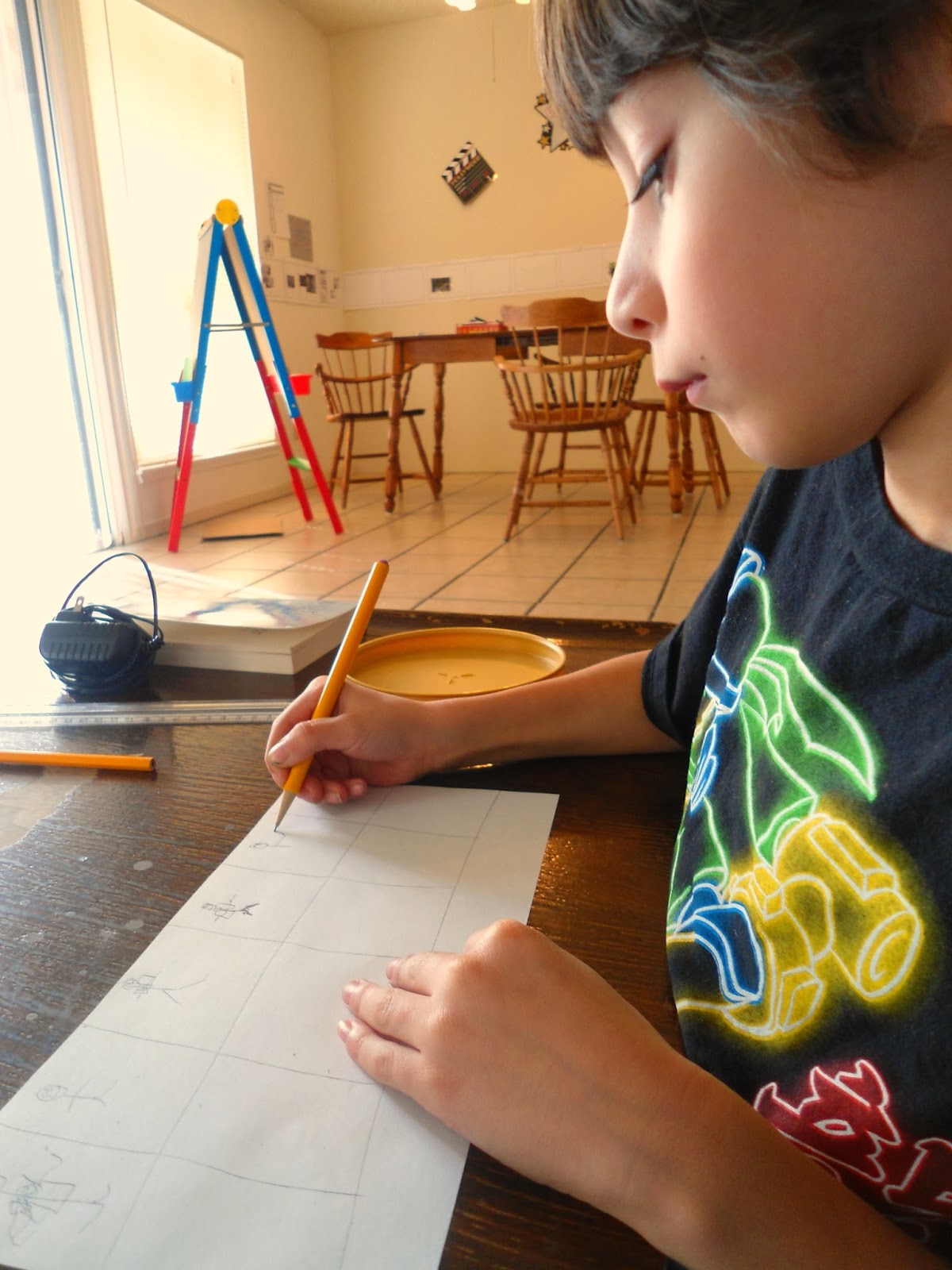
Aidyn practicing some sketches.

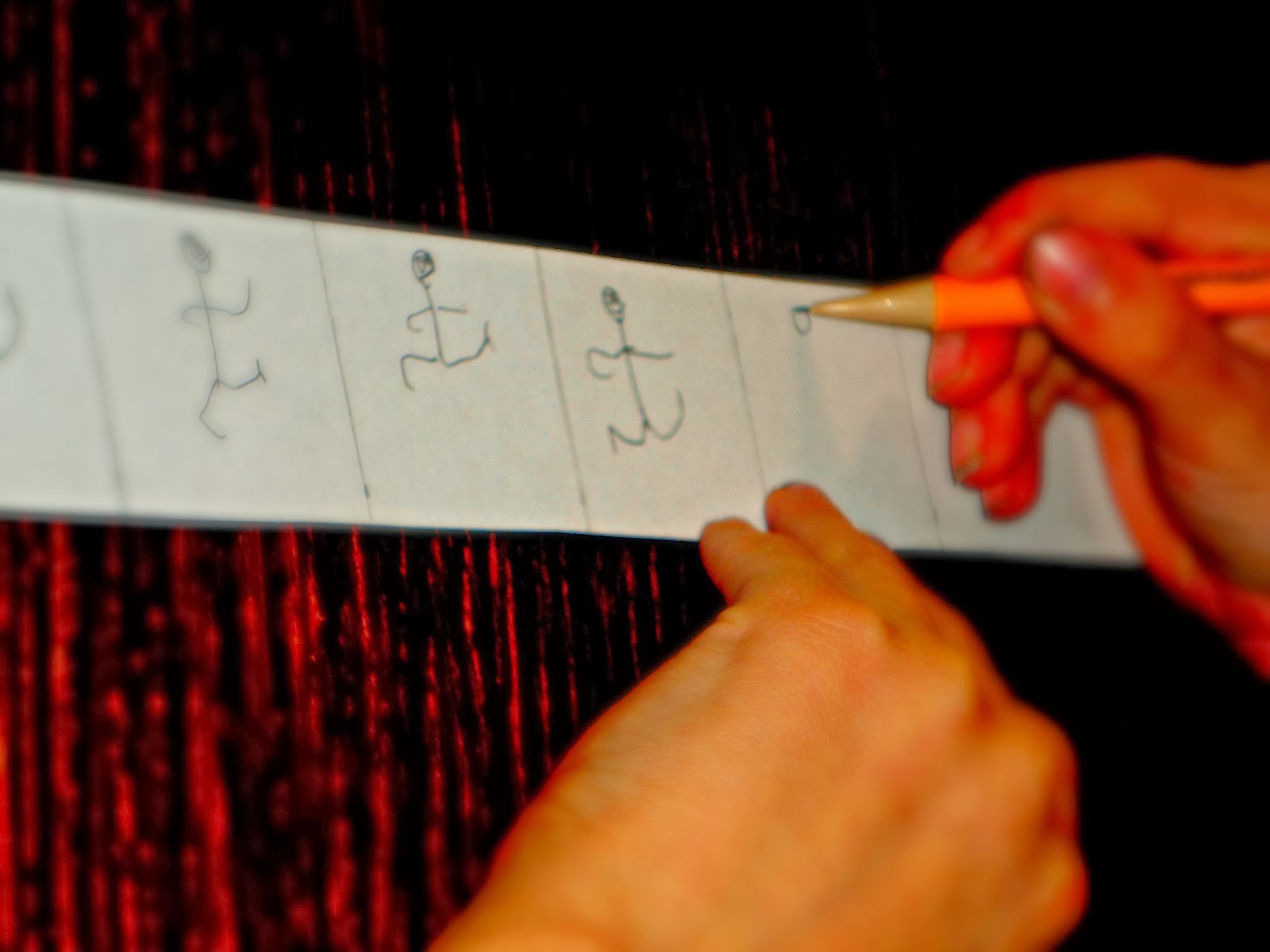
Drawing animation on the cels. 

"A guy running," he says.

Spin!

I'm pretty sure he will appreciate television and instant cartoon availability much more now...

We still have a far way to go. Next time, we'll be learning about the history of film and tracing both animation and film through the decades. 


Check back to see what we do!

Friday, January 3, 2014

Looking Back at 2013 and Ahead to 2014

January 2013~


Night of the Moonjellies~David's birthday~Karate~Space unit study~

February 2013~


Domino Rally~Learning about Lincoln~Adventure Time


Disneyland family trip~Aidyn's first time on Indiana Jones~Beautiful memories~Screaming on Goofy's Sky School~ Laughing at the Aladdin show~

March 2013~


Chaffee Zoo trip~Forestiere Underground Gardens~India unit study~Water tornadoes~Forts in the living room~Bowling on Sundays~Birthday bowling with Grammy Tami~Easter

April 2013~

Some good and some bad in April...


Making custom shirts~Aidyn's first official running race in Lancaster, Ca~Family trip to Charlie Brown Farms~Mini-getaway to Disneyland~Aidyn's first time on Autopia~David in the hospital with double pneumonia~David SURVIVED double pneumonia~Apples unit study

May 2013~


Spooky Storytimes~Forts in the dining room~Avocado ice cream~David's recovery

Summer 2013~


Water balloon fights~Outdoor play all day with friends~Library shows with friends~Reading books~Playground fun at friend's house

August 2013~

First day of second grade~Spelunking at the Moaning Caverns


Back to school~Saxon Math~Story of the World~Ancient Civilizations~Making a Shaduf~Mama goes to school to finish Bachelor's Degree

September 2013~

Surprise trip to Disneyland for my best friend, Amanda


Surprise morning visit~Driving and chatting on the way~Paper sculptures at Denny's~Reservations mix-ups~Breakfast at Tiffy's~Excitement~Little Mermaid ride~Screaming ridiculously on Goofy's Sky School~Our first time on Radiator Springs Racers~Halloween decorations~Space Mountain~Indiana Jones~Star Tours~Matterhorn~A million restroom breaks~Yummy Disney desserts and coffee~Monsters Inc.~Dinner at Flo's Diner


Ancient Egypt unit study~Painting a map of Egypt~ Making the Nile River, papyrus and cuneiform tablets~ Apple head preservation experiment~Busy with college~Preparing to move

October 2013~


Moved to a new home in a new town~Yearly Walk for Autism~Enjoying our new backyard~Writing stories~My and David's 12th Anniversary and 11th Wedding Anniversary~Ukulele classes~Art classes


Halloween~Carving pumpkins~Trick-or-treating~Fundraising for AFSP~Running regularly~Still busy-busy at college

November 2013~


Training for the half-marathon~Stellaluna~Ukulele playing~Fall unit study~Friend's wedding


Fire Station field trip~Thanksgiving~31st birthday~Best birthday present ever~

December 2013~


End-of-semester stress for Mama~Running~Winter Stories~Christmas crafts~Making snow and ornaments~Watching Christmas movies~Christmas morning~Aidyn's 8th birthday

Many people claim 2013 was a bad year. It had some rotten moments, most notably David's health scare, but I see it as a year of success because he survived and is now in much better health and working on new physical goals. We had a busy but colorful year with many good memories. I'm thankful for the trials, the growth, and the solidarity each has inspired in us.

~~~~~~~~~~~~~~~~~~~~~~~~~~~~~~~~~~~~~~~~~~~~~~~~~~~~~~~~~~~~~~~~~~~~~~

Our one-word goal for 2014 is Adventure. We enjoy those moments we spend outdoors, hiking, spelunking, exploring and traveling just as much as we love those magic moments at home. We'd like to create more of both this year.